Read or Jump On
Survival stress - Effects of increased heart rate
The most important means to survive a deadly clash is neither weapon nor martial skills. The main tool is the ‘combat mentality”. (Col J. Cooper)
To fully understand the intensity of mental stress resulting from combat, we need to take into account other environmental stressors, and at the same time study the physiological responses of the body related to the sympathetic nervous system. Furthermore, it would be worth analysing the fallout caused by the sympathetic nervous system when it is overloaded (Col. Grossman)
Introduction
In the previous article we dealt with the effects of increased heart rate due to hormonal causes or fear.
We discussed the concept of mental states and attitudes that lead an individual to face potential danger.
We have seen the Effects of increased heart rate related to survival stress situations.
All coded with the colour code introduced by Col. Cooper.

Cooper Colour Code
Simplifying the colour code conditions we have:
White – BAD AND UNPREPARED – Unprepared and not ready to take lethal action. If you are attacked in white, you will probably die unless your opponent is totally incompetent.
Yellow – RELAXED AWARENESS – I may have to defend myself at some point today. A state of relaxed alertness.
Orange – SPECIFIC WARNING – something wrong has caught your attention and you are focusing mainly on it, you are ready to take action, but you are not in a lethal mode.
Red – COMBAT – You are in lethal mode and will act immediately with deliberate aggression if the circumstances warrant it.
We concluded by saying that, in order not to be completely unprepared for unusual behaviour and potential threats, it is useful to be relaxed but at the same time be aware of the people and sounds around us, which corresponds to a Yellow condition.
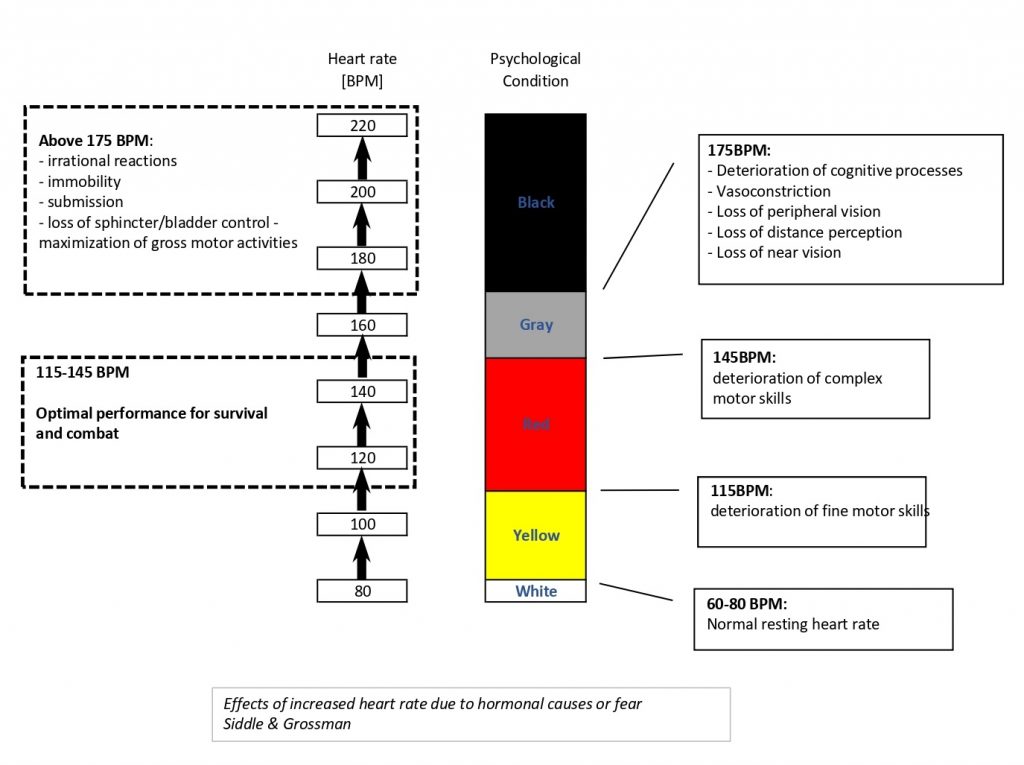
Finally, we mentioned the Grey and Black conditions that occur above 145 BPM.
These are psychological conditions of high stress in which interesting factors often unknown or hidden come into play, for which I thought it useful to devote a specific article.
Please note: Setting precise boundaries to heart rate values for various colour conditions is not entirely correct, these can be subjective depending on factors such as fitness or other.
The heart rate increases considered here are related to survival stress situations. Similar frequency increases due to physical exertion do not lead to the same psychophysical effects. The two causes can, however, add up.
It must be borne in mind that each of us has his or her own colour condition; what is stated here is not to be applied to each of us to the letter.
Fear, What it is
Fear is one of the fundamental emotions of living beings. Fear is a primary emotion fundamental to survival
When one experiences fear, both physical and psychological changes are triggered. At body level, one can experience: dry mouth, increased heart and respiratory rate, intestinal motility, muscle tension, increased sweating. This triggers the production of the hormone adrenalin, which prepares us for the reaction.
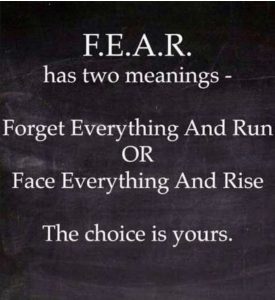
The main immediate responses to fear are flight, attack and immobilisation, but each individual reacts in a specific personal way.
Fear is often accompanied by an organic reaction, for which the autonomic nervous system is responsible, that prepares the organism for the emergency situation, arranging, albeit in a non-specific way, for the preparation of defences that usually translate into fight-or-flight attitudes’ (Wikipedia).
In this paragraph, I talked about how to manage fear
Grey Condition
Acclimatisation to stress
Under a stress situation, the heart rate increases. Above the 145 bpm threshold, however, there is a catastrophic drop in performance.
This condition is termed a grey condition because apart from being the antechamber to the black zone, it is in fact a grey area that is being further investigated in the military.
It has also been found that the drop in performance does not apply to everyone: those who are well exercised are able to remain in a red condition even above 145 BPM while maintaining good efficiency.
This process is related to a kind of acclimatisation to stress or, put in psychological terms, to a condition of stress inoculation. This is analogous to the concept of immunisation where moderate doses of pathogens are inoculated.
Stress inoculation has an effect on the cognitive level. The concept is that of increasing self-confidence through real training that increases the sense of personal efficiency and self-confidence, resulting in a reduction of stress in real situations where we do not have time to think.
One example is the firefighter or parachutist. None of us ordinary people would handle a fire or jump quietly into the void, but both figures have made a job of it simply because they have been immunised against fire or jumps from a plane respectively
‘No man is afraid to do what he knows he can do well’
Duca di Wellington

Manager and acclimatisation to stress
From personal experience, I believe that the concept of stress acclimatisation is also applicable to situations other than combat, such as managing stress at work.
I was self-employed for a few years when I was in Italy, and in 2008 I experienced the economic crisis in full (I had already faced a lighter one a few years earlier) and had to manage problems related to low liquidity, such as managing payments to employees and suppliers. I dealt with this issue by putting my face to the grindstone until the very end, never shying away from the various discussions that arose, and eventually managing to maintain a good relationship with everyone. As proof of this, I still keep the same phone number years later.
I make no secret of the fact that at times disappearing would have been easier and less stressful, but I am proud to have been found, this was also one of the secrets of my success.
Be Conscious
These days, reading a new book on Bruce Lee’s philosophy, in a paragraph entitled “Be Conscious” I read:
“to be in the ‘flow’ means in part to be present, to choose to live one’s life consciously. Being present is more than occupying physical space, it is also about actively participating. Being present is a key component of being like water…We can choose to stop at the first obstacle or to continue…”
In 2010, I joined the purchasing department of a large multinational company as a clerk. I had to manage some critical situations with suppliers that were bankrupt but strategic for the group.
In order to manage these situations, I was away for several weeks at the headquarters of the various suppliers, I had to interface with the CEO of my group for economic management and with the various logistics, in Italy and outside Europe, for production and shipment management.
I had to manage employees, who were obviously worried about their future, and suppliers who wanted to block deliveries.
Based on my personal experience, it was an ‘almost fun’ challenge for me, and I managed to complete my missions successfully and without any inconveniences or production stoppages for my group.
I then moved to Germany to take up a new role and was immediately put to the test with suppliers new to me and procurement issues. Trials well passed with much praise from my management.
Over the years, I have always been asked how I can cope with overwork without panicking and going into stress. I believe the answer lies in my previous experience where I had to deal with exhaustion and tension, in comparison, what came after was a piece of cake for me.
Recently, the exact opposite has happened to me. For the past two years, due to the pandemic, there has been a drop in work and I have been working a lot in the home office. After the summer, I experienced a rapid return to normalcy, and I must admit that initially I was in danger of becoming fatigued and stressed…but experience helps ;-)
Be water my friend
Siju Bruce Lee wrote: One has to grow through wise frustrations, otherwise there is no incentive to develop one’s means and techniques of approaching the world. His daughter Shannon today in her book ‘Be water my friend’ interprets her father’s words by writing that there is nothing more fair because if you never expose yourself to anything difficult or complex, the first time something difficult or complex happens you end up with no idea how to react. Or one stays put.
A psychology article on Management and stress states:
‘Confidence in one’s own resources and experience and constant basic preparation enables us to respond to crisis effectively and reduce stress.

Stress acclimatisation in combat
In a military environment, various stress performance tests are carried out, and training is done under high stress.
An interesting finding was that properly trained subjects are able to extend their red condition to the limits of the grey condition, achieving the best performance results at a heart rate of around 175 bpm. A similar situation has been found in car drivers. Keep in mind that fine motor skills are lost in this condition anyway.
I am reminded of when at one of our summer camps we invited instructors from the Folgore Parachute Brigade. At the beginning, for the athletic part, they asked me whether they should go light or do a workout to their standards, I obviously opted for the latter.
For about half an hour it was like being in the film Full Metal Jacket (I exaggerate), four instructors giving orders by shouting at the boys (of mixed sex) as they engaged in the various exercises on offer.
They had taken a normal workout to a high state of stress simply by using an aggressive attitude and high intensity, adding a psychological and intimidating aspect to the athletic training. I must say that on that occasion the boys made us look very good by passing the test brilliantly.
The boys were somewhat accustomed to certain stressful situations and did not panic.
This is what I mean by real training.

KISS
Staying with the focus of the blog and thus the concept of self-defence, it is important to effectively learn certain skills and automate them in the form of autopilot.
The example of driving is still relevant: initially we have to think about every movement we have to make; later, with practice, when faced with an obstacle, we automatically perform a series of movements without thinking, such as braking, changing gear and steering.
In learning the necessary skills, it is therefore necessary to reduce options to a minimum. A concept already expressed by Sun Tzu.
The US Navy in design adopts the KISS (keep it simple stupid) principle. According to this principle, simplicity should be a key objective in design and unnecessary complexity should be avoided.
Hey but doesn’t all this remind you of the basics of real combat principles analysed by Bruce Lee (I recommend my article on Jeet Kune Do).
It is worth mentioning that in addition to stress inoculation, another method of controlling physiological responses is tactical breathing, considered a true revolution in warrior training. But I will eventually dedicate a later article to this one
There is no shame in failure, the only shame for a warrior is not to try.
Col Grossman
Black condition
Here, one enters a psychological condition of high stress in which various symptoms occur, in addition to the deterioration of complex motor skills and a catastrophic drop in performance. A drop in performance and perceptual distortions that seems to be linked to a form of survival mechanism.
On a medical level, what we know is that above a certain level of heart rate, the heart pumps so rapidly that the heart cannot fill with blood adequately, as a consequence, there is a reduced effectiveness of the cardiac action and the circulation suffers, the level of oxygen supplied to the brain drops dramatically.
I would like to remind you that we are talking about increases in heart rate caused by fear stress and not by exercise. In our case, the SNS reacts to stress by releasing hormones into the body. We are asking the body for extreme physical performance while vasoconstriction is taking place; two conflicting processes that cause the heart rate to spike.
Stress response
Faced with the onset of stress, the first system to be activated is the autonomic nervous system (SNA), the increase of noradrenaline in the innervated organs is stimulated and the secretion of adrenaline will also increase, reinforcing the effects previously produced by noradrenaline.
Increasing noradrenaline and adrenaline results in the following:
- Increased intensity and number of cardiac contractions.
- Muscular and cardiac vasodilation and coronary arteries.
- Increased respiratory rate and dilation of the airways (promoting lung ventilation).
- Peripheral vasoconstriction.
- Increased sweat production (due to heat dissipation).
- Reduction of short-term non-vital physiological processes (inflammation, digestion, reproduction and growth).
- Stimulation of hepatic glycogenesis (glucose production).
- Inhibition of insulin secretion and stimulation of glucagon in the pancreas (high glucose levels).
The body tries to maintain a balance to counteract the undesirable effects of stress by activating numerous processes this is known as the stress response
Let us therefore see what transformations are created in our body and mind by activating the black condition.
Irrationality
From a physiological point of view, the anatomy of the brain has three distinct parts, namely the forebrain (or anterior brain), the midbrain (or middle brain) and the rhombencephalon (or posterior brain).
Under the effect of a big scare, the forebrain switches off, leaving control to the midbrain: one loses rationality
For the more curious I recommend reading Anatomy of the Brain
Vasoconstriction
When the organism intercepts a stressful situation, the body activates a series of physiological and metabolic changes to adapt, among which we have the decrease in the diameter of the blood vessel through which blood flows, also causing an increase in pressure.
An example of vasoconstriction and loss of fine motor control is when our hands freeze in the cold: the fingers turn white and do not obey commands. In the red condition there is an initial loss of fine motor control, in the grey condition we begin to lose complex motor control, but in the black condition the effects of vasoconstriction are catastrophic. This means that while at minimal levels of vasoconstriction only the smallest capillaries are affected, in a more intense vasoconstriction condition the muscle groups responsible for complex motor control are also affected.
It is strange to think that our body activates a sort of survival mechanism, the outer part of our body no longer being irradiated with blood acts like armour, limiting blood loss during a fight. As a negative effect, however, there is a decrease in motor control.
The opposite effect to vasoconstriction is vasodilation with the consequence that the skin turns red and wounds created in combat bleed.
Being blinded by fear
It may sound like a figure of speech but in fact under stress conditions there is a loss of peripheral vision. The greater the stress, the narrower the visual tunnel becomes. One loses depth perception and close-up vision.
Under these conditions, even the simplest tasks, such as dialling an emergency telephone number, become difficult unless properly automated.
This is why police and military operators train and automate simple gestures such as loading a weapon.
Hearing reduction
Our brain is trained to select stimuli by discarding some of them. It is believed that under stress this filtering is more pronounced, keeping only the sound stimuli necessary for survival. Even in low visibility situations, vision is switched off and hearing is switched on.
It may happen to soldiers that they do not hear their weapon fire or that they do not experience the annoying whistling in their ears after firing.
Don’t feel the pain
A sensation that most of us have surely experienced when we find abrasions or bruises on our body as a result of an activity in which we are intensely engaged.
This is referred to as sensory exclusion
Remaining speechless
In Condition Red it is common to experience a drastic decline in the ability to speak. In Condition Black, on the other hand, it happens that one is completely dumbfounded.
It happened to me as a boy, for example, that following a car accident I was surprised to have difficulty speaking and pronouncing words by slurring sentences, it was as if I had a tongue lolling.

Conclusion
We realised the importance of real training to create acclimatisation to stress as only what is really assimilated in training emerges in the stress situation.
Whatever is internalised in training jumps out at the moment of truth. This is why I am for example very critical of ‘low’ contact Personal Defence courses: if you train without contact you will not seek contact when you need it. Just as if you get used to not practising a technique in its entirety, perhaps because you take it for granted that you know it, you risk stopping when you really need it.
Let’s not forget, however, that there are regulations that must be adhered to.
In this article we have given an explanation of some sayings about fear and stress:
- being shocked by fear (forebrain shuts down)
- not seeing from fear (loss of vision, loss of depth perception and close-up vision)
- shitting oneself from fear (loss of control over sphincters and viscera)
- dumb from fear
I hope you have found the notions presented in the last two articles interesting. Personally, when I first became aware of our body’s reactions under stress years ago, I was quite surprised at how nature has endowed us with such a complex yet combat-friendly machine. On the other hand, it must be remembered that our ancestors did not lead such a comfortable life as most of us do today. Man originally had to fight every day to survive and lived in a constant state of wakefulness. Now we have become civilised and our alertness levels have lowered but it is important not to let our guard down too much and be aware of the people and sounds around us and know how our bodies might react to fear and stressful situations.
As mentioned in this article, knowing helps to deal with critical situations more efficiently and effectively.
Let me know your opinion