


Read or Jump On
SELF-DEFENSE - THE LAW
In the previous article I set the tone for the blog by providing an initial overview of what I personally see as the hidden side of self-defense.
I believe that before moving on, it is important to devote an article to an overview of the relevant legislation.
I will use Art.52 of Italian law (which is rather complex compared to other European realities) as a reference. I will also provide information on the norms of other European countries.
Unfortunately, it is atopi, that of self-defense, that cyclically returns to the news in the wake of news events
The purpose of the article is to give general information of the legislation on self-defense, it is important to know what we are allowed to do and not to do.
The Law always remains the reference to be followed.
The following article is not intended to substitute for the judgment of law enforcement.
For more in-depth information on the subject, we recommend specialized sites or legal advice
Art.52 and the regulatory framework
The institution is regulated in Article 52 of the Criminal Code, which states in Paragraph 1:
A person is not punishable who has committed the act because he was compelled to do so by the necessity of defending his own or another’s right against the present danger of an unjust offense, provided that the defense is proportionate to the offense.
In 2006 this Article 52 was amended as follows:
People who shoot an armed burglar who has entered their home or store will no longer risk jail time for excessive defense. This is provided for in the bill finally approved by the House on Jan. 24, 2006. The measure amends Article 52 of the Criminal Code on self-defense. The new provision states, in fact, that the victim of a robbery, robbery or threat may retaliate “in order to protect his own safety” and that of his loved ones in his home, professional office or store when the attacker does not show that he will desist. In this case, even shooting is no longer an excess but self-defense.
The reform of Art.52
With the 2019 self-defense reform, the law definitively established that in cases of home invasion, the defense is always proportionate to the offense, provided, of course, that all the other elements that constitute self-defense (danger to one’s own or others’ safety, etc.) are met.
Pursuant to Article 52 of the Criminal Code.
a person who has committed the act because he was compelled to do so by the necessity of defending his own or another’s right against the present danger of an unjust offense shall not be punishable, provided that the defense is proportionate to the offense.
Law 36 made the presumption absolute, specifying that the proportion of self-defense, in these cases, is not subject to the discretion of the judge, and that “always acts in a state of self-defense the one who performs an act to repel the intrusion posed, with violence or threat of use of weapons or other means of physical coercion, by one or more persons.”
In addition, Article 55 expressly stipulated that in the same situations of aggression in the home or at workplaces, punishability is excluded if the person who committed the act act acted — for the protection of his own or others’ safety — in a condition of diminished self-defense, or in a state of serious disturbance, resulting from the situation of danger in progress.
Sentence 2019
The jurisprudence of legitimacy, however, immediately significantly narrowed the margins of application of the new rules, based on the assumption that “the use of force, such that it can lead to causing, even unintentionally, the death of a man, is to be considered justified only if ‘absolutely necessary’ to ensure the defense of persons from unlawful violence” (judgment 19065/2019)

Self-Defense, Prerequisites of
Self-defense, should not be confused with revenge, a reaction that follows injury, and is a reaction that comes before injury, as the only possible remedy to avoid an unjust offense
It is centered on two essential assumptions.
On the one hand, the unjust aggression that results in the occurrence of danger, and on the other, the legitimate defensive reaction.
“Unjust Offense.” What does it mean?
It is one of the essential elements of self-defense under Article 52, consisting of an unjust aggression, i.e., contrary to precepts of the legal system or otherwise not expressly authorized by it, and such as to legitimize the reaction to the aggression.
“Need to defend.” What does it mean?
A necessary condition for legitimate defence, consisting of a situation in which the agent has no alternative but to react in order not to suffer the unjust aggression, an inevitability to be assessed in concrete terms, at trial, taking into account all the circumstances of the case.
“Present danger.” What does it mean?
This is one of the four essential elements of self-defence under Article 52, consisting of an impending threat of a direct offence to one’s own or another’s right, which must exist at the time of the reaction and not at a previous or future time.
I would like to emphasize what is stated in the last part of the text of the law:
Provided that the defense is proportionate to the offense.
This means that in front of a fist threat I cannot respond with a weapon or worse. And equally it states that the offense must be real and unjust.
Arms
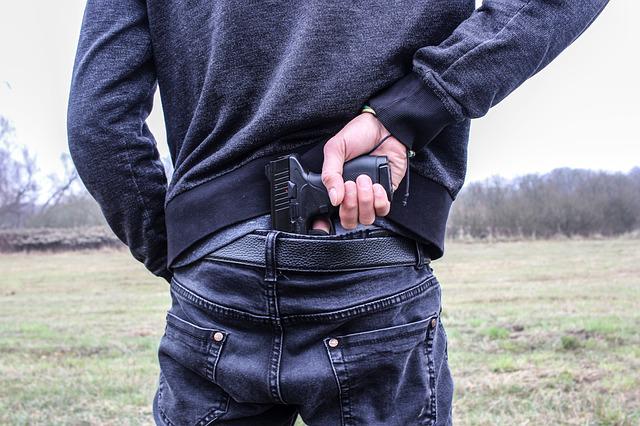
The use of weapons
The use of weapons to defend oneself is not always a legitimate reaction, even in the case of a home invasion.
Not even after the amendments introduced by Law 36/2019, with the aim of excluding the punishability of those who, while defending themselves at home or at their place of work – as in the case of robbery in a commercial establishment – kill or injure the intruder. Certain mandatory limits, beyond which the defence is unlawful, must still be respected: the danger of the offence must be present, the attack must be directed at persons and not at property, and the defence impossible with an alternative action
Arms. Definition
For the purposes of criminal law, ‘weapons’ means
- firearms and all others whose natural purpose is to offend the person;
- all offensive instruments, the carrying of which is prohibited by law without justification
Instruments designed to offend. Identification
The law also identifies offensive instruments:
are not weapons, but tools (Art. 4 L. 110/1975): knives of any kind and size (see above for flick knives), bows, crossbows, spear guns, hatchets, scissors, awls, martial arts sports equipment, etc. That is, any instrument that can injure, but is intended for another purpose as a sporting or working tool. These tools are freely available for purchase and transport; they may only be carried for justified reasons, i.e. to be used for their primary purpose.

Personal defence in the street
Having said that, and given an overview of the relevant legislation, I want to focus on Personal Defence in the street. We are therefore in a public place where in theory I am not allowed to have weapons.
(Except for the authorisations provided for in the third paragraph of Art. 42 of the Consolidated Law on Public Security 18 June 1931, no. 773, and subsequent amendments, weapons and offensive instruments may not be carried outside one’s home or belongings. – Law 110/1975 – Article 4).
Taking it for granted that the law is respected, street Personal Defence uses our own body as the means of offence/defence, perhaps making the concept of defence proportionate to the offence more difficult as fist answers fist and the variables involved can be difficult to apply as how can a judge define an excessive defence?
Types of self-defence
I consider that Personal Defence, as such, can be divided into two types:
- Defence against a possible threat
- Survival
The first is when we feel threatened and before the threat has even become real we proceed to attack. E.g. when we are arguing with a person who we think is about to hit us and we precede a possible attack by striking first.
In the case of Survival the threat is real and we are grabbed or hit or, even worse, in the case of attempted rape, we are knocked down. In this case we have to defend ourselves against something that is really endangering our lives and we must have the readiness to be able to react to get out of a situation that is risky for our Survival.
In the two cases, the first situation is the most difficult to handle as we risk being punishable by law since the defence is clearly not proportional to the offence and we would risk a trial by intentions, which is clearly not possible; think of the person who, on encountering a guy coming out from around the corner in a dark alley, hits him out of fear of being attacked.
Having said the above, it is common sense that counts, which should tell us to avoid risky situations in the ways we find in hundreds of manuals on Personal Defence and, in the event of a possible threat, such as an argument over a parking space, it must always be common sense that will make us understand the possible risks and threats that may arise and behave accordingly, the important thing is to respect certain rules that will be the subject of a future article.
The Three Levels of Self-Defence
I believe that according to the situations and its applications, Personal Defence can be classified into three levels:
- self-defence with evasion
- self-defence with control or submission
- ‘destructive’ self-defence
I Livel
The first level, which may seem the simplest, consists of delivering a precise blow to the aggressor sufficient to get him out of the possible threat, creating a shock, in order to flee to safety.
It is a fact that often the offender, surprised and disoriented by an unexpected and decisive reaction, prefers to abandon.
Although it may not seem like the easiest situation, it actually requires precision and cold blood; an ineffective blow could lead to a more violent reaction from the attacker.
II Livel
Control and submission presupposes that after an initial reaction to aggression, a control technique such as joint locks and/or strangulation is used.
This type of defence in addition to being applied, for clear reasons, by law enforcement agencies is used by the experienced fighter who does not want to cause serious physical harm to the aggressor and wants to seek a ‘peaceful’ solution by demonstrating his superiority.
III Livel
The last level and the most extreme and most violent solution where we set no limits and the only goal is to render the aggressor harmless.
Such a reaction should be applied in the case of armed aggression (the aggressor has actually threatened his own or other people’s lives) or in the case of aggression by several persons.
Finally, let us remember that although the law forbids it, so-called ‘white’ weapons (swords, daggers, knuckle-draggers, animated sticks, clubs, truncheons, electric stun guns, tear gas canisters not approved by the ministry), especially if small, can be concealed in the aggressor’s pocket, so always keep your eyes open and your reflexes ready (see the Training Vs reality article) and when possible, your legs fast.
There is little point in being a hero and in some cases it is better to walk away than to risk your own life or that of those with you.
Self-defence, the rules abroad
France
France (Articles 122-5 and 122-6 of the Criminal Code) is the closest solution to Italy:
a person who, in the face of an unjustified attack against himself or another person, commits, at the same time, an act imposed by the necessity of self-defence shall not be criminally liable, unless there is disproportion between the means employed for the defence and the seriousness of the attack.
A person who, in order to interrupt the commission of a crime or offence against property, commits an act of defence, other than voluntary manslaughter, when this act is strictly necessary for the purpose pursued, as long as the means are proportionate to the seriousness of the offence, shall not be criminally liable.
As in Italy, there is a requirement of proportionality between defence and offence
Germany
In Germany, the regulation of self-defence is regulated in sections 32 and 33 of the Criminal Code. According to these rules, self-defence is defined as self-defence:
that defence which is necessary to repel a present attack by oneself or by others: therefore, one who commits an act compelled by self-defence is not legally acting in self-defence. Provision is also made for non-punishability for those who exceed the limits of the defence by reason of disturbance, fear or panic
According to these standards, the aggression is required to be present and actual. No reference is made to proportionality between defence and offence.
A ground for non-punishment is provided for in cases of disturbance, fear or panic. This includes cases of surprise attacks, such as the case of a night intruder in a family home and one of the inhabitants, panic-stricken, reacts in an exaggerated and irrational manner.
Finally, one who exaggerates in the manner of defence is not chargeable: one who fires a shot, for example, even when it would be sufficient to threaten to do so.
United Kingdom
In the United Kingdom, the notion of self-defence was delimited in 2012 (Legal Aid, Sentencing and Punishment of the Offenders Act. On the other hand, among the circumstances to be considered for the application of the exemption*, the law explicitly refers to the behaviour of the aggressor in relation to his flight or desistance. In 2013, the latest intervention was made to include the defence of one’s place of residence against the unauthorised intrusion of third parties among the legitimate purposes of even a disproportionate use of force.
* In legal language: exonerating cause, the cause of exclusion of criminal liability
Spagna
Spanish self-defence, like German self-defence, does not explicitly provide for proportionality between offence and defence and contains the hypothesis of panic-induced self-defence.
Furthermore, in the case of defence of the dwelling or its dependencies, undue intrusion into them is considered an unjust aggression.
The Spanish code differentiates the case where the defence concerns persons or property
The institution of ‘incomplete defence’ is provided for, which only guarantees the agent a mitigation of the penalty in cases where, according to case law, there is a disproportion between defence and offence.

Conclusion
I realise it is a complex subject to digest and understand, but it is important to have a general and superficial understanding of self-defence legislation.
People practise martial arts, perhaps even taking a self-defence course, and feel free to beat up, hit, beat up someone in the street simply because he disrespected them, looked at their girlfriend or because they disliked him.
Fighting and ‘defence’ techniques are taught without being made aware of the legal consequences of any actions against other people.
People do not always understand what self-defence really is, even from a legislative point of view.
It is often confused with revenge, or as a means of taking justice into one’s own hands.
That is not what it is about….
Better a bad trial than a good funeral
I know you often hear the saying ‘better a bad trial than a nice funeral’ but, as reported on the Italian Police website, which describes an officer’s outburst, those who say this have never been through the courtrooms.
“Bad trials last for years, during which you are often left alone to defend yourself not only from the charges but worse still from the mass media who do not hesitate to crush you, destroy you, massacre you, you who do not have a flock of lawyers but most of the time a friend or a magnanimous lawyer who helps you because ‘fool’ like you who still believes in common sense, in Justice and the Constitution. Bad trials do not kill you immediately like a stab wound to the heart might, they consume you slowly, first you lose your friends, then your family and in the end you may even end up being acquitted for not having committed the crime and in the meantime you have lost everything as an innocent man.
The nice funeral, on the other hand, exempts you from everything”.




Your posts always provide me with a new perspective and encourage me to look at things differently Thank you for broadening my horizons
Thanks