

Read or Jump On
What is Jeet Kune Do
I cannot avoid dedicating the second article of this blog to a first introduction of Jeet Kune Do (JKD).
JKD is the fighting method created by Bruce Lee, but I think it is limiting to consider it only a fighting method.
We are in the 60s when Bruce Lee arrives in America. In China, he was considered a good fighter and was used to street fights. In America,
Bruce discovered various forms of fighting, the Americans were bigger than him… His Wing-Chung was in danger of not being effective.
Jeet Kune Do was created for real combat through the study of combat in all its forms, allowing it to adapt to any situation.
JKD cannot be classified as a martial arts style as it is a style without a style, so to me it is more of a fighting philosophy.
Unlike classical martial arts where every technique is codified, Jeet Kune Do allows you to learn to manage the unpredictability of combat, whether real or sporting. (Check here)
JKD in short
In the JKD prevails the study of standing combat using upper and lower limbs to deliver blows with punches, kicks, open hand strikes, elbows, knees and any part of the body capable of offending and defending.
In JKD is developed the study of trapping, originating in Wing Chung, which is a fighting technique designed to control and trap the opponent in the short distance allowing to fight in tight spaces or when the opponent is
too close to use long blows such as punches and kicks.
Jeet Kune Do is also Grappling, with which the technical background is completed, allowing for confrontation in the fight, projecting and exploiting the joints to subdue the opponent.
Footwork plays an important role since it allows one to move in combat in a simple and effective way, managing the distance with the opponent, looking for the best situation to deliver and avoid blows.
JKD – The main themes
The main themes on which Jeet Kune Do is based are:
SPEED
DISTANCE
TIME
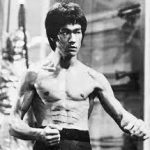
the correct management of these three elements form a fighter who is able to adapt and face the multiple situations of combat.
Jeet Kune Do provides an intense physical work to improve one’s body, muscular strengthening, aerobic work, improvement of flexibility and speed of the body to be stronger and more resistant fighters.
With the evolution of modern martial arts today it is difficult to understand the enormous revolutionary work done by Bruce Lee. One has to project oneself back to the 1960’s when the known Martial Arts were the traditional ones, which I have talked about here (link), including Boxing and when Asians were not well seen in the New Continent.
Lee was among the first to study fighting methods in a practical way for real combat in order to create the principles for the development of a personal fighting method.
There are those who attribute the birth of MMA and modern Martial Arts to Bruce Lee.
Taking my cue from an article I wrote a few years ago after attending a Jeet Kune Do self-defence lesson, let us look in more detail at the principles of this philosophy.
On that occasion I realised how often the basic principles of this PHILOSOPHY are overlooked.
What is Jeet Kune Do
Explaining Jeet Kune Do is not easy and an article is not enough. It is not enough to have studied with a student of Bruce Lee to understand the greatness of this method of combat. In the course of his short life Bruce Lee began a journey that we cannot know how and when it would end.
In order to understand JKD you need to have a global vision, like a puzzle you have to put the pieces together, something Tommy Gong has done very well in his book “Bruce Lee – The evolution of a Martial Artist“.
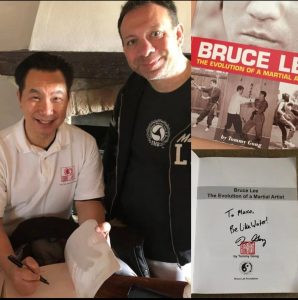
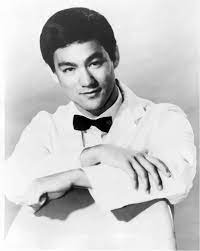
Jeet Kune Do contains principles that can be applied to any combat discipline.
JKD was created to make one’s own fighting style more effective as shown in the video below that I created about ten years ago and which I show the difference between the traditional defence method and the simple JKD method.
If you are curious to learn more and have the patience to read on, I will go over some of the main principles below.
Happy reading
No Style and Freedom of Expression
One Style No Style
So “I can do what I like”?
NO!
No style means that the fighter should not bind himself to an established style and movements but express his own creativity.
This means that you do not have to think with the mentality of the Boxer, the Karateka, the Savate, Kick or Thai practitioner, but you have to be able to be everything and nothing at the same time.
In order to be free from schemes it is necessary to have a knowledge of the DNA of the various fighting styles without binding oneself to any of them, it is necessary to be able through the experience and the guidance of the trainer to create one’s own fighting style, this does not mean not following principles.
The Jeet Kune Do artist is an eclectic martialist who is difficult to interpret and is able to adapt to various situations thanks to the fact that he does not belong to any defined practice.
Since there is no codified style, each athlete should find his own method.
Unconventional
One of the principles that over the years has created a lot of confusion, facilitating the proliferation of Jeet Kune Do courses justified by “I put together a few techniques and do what I want”.
I believe that when Bruce Lee talked about being unconventional he meant surprising the opponent by doing something uncodified and unexpected.
Let’s not forget that when JKD was born there were only traditional styles characterized by static and movements by patterns. (e.g. he attacks like this, so I have to do this). For Bruce, there was no single response to an attack, but it was necessary to be dynamic and creative, he loved to surprise his challengers by doing different things in its simplicity.
After the advent of Lee the traditional disciplines were contaminated by the philosophy of JKD undergoing changes.
Care of the technique by eliminating the superfluous – Simplicity and economy of movement
Our weapons in real combat are first and foremost our bodies.
We need to repeat even the simplest technique (e.g. the jab) hundreds of times to understand its various facets, weaknesses and strengths.
We must be able to avoid involving the antagonist muscles and eliminate superfluous movements to make the movement as fast as possible. The mirror, or the camera, are excellent tools we have at our disposal as they allow us to see the way we move and correct any small mistakes.
The Jeet Kune Do artist is a perfectionist who takes care of every detail of his movements to make them more effective. Bruce Lee repeated hundreds of punches every day and yet he knew what a punch was
Being direct
My punches must have direct, linear trajectories.
The blows must have a starting point A and a finishing line B with no further steps (C).
Very often you see punches being thrown with rotations of the shoulder which leads to raising the elbow, uncovering the hip but above all slowing down the action by executing longer trajectories.
The blows must start from the guard position, arrive at the target moving linearly and return following the same trajectory.
This avoids unnecessary waste of time and energy by giving the shots more power as they are faster.
Guard
It must never be forgotten that those who practice real fighting (street fighting) are training to deal with a possible street attack and are not training to mount in a cage or a ring with protections and a referee ready to intervene.
In the street, the aggressor will use his own body or any blunt instrument he can get his hands on.
The guard in these situations is fundamental because he cannot be too close to our body, which would prevent us from intercepting the attack in time, exposing our body and our head. The bare hands are much smaller than when protected by a glove (they have a greater penetrating power) if we keep the guard very close we risk that the blow of the adversary has a greater probability of reaching its mark, furthermore, any blows on our guard would create a shock by recoil.
The guard will have to be slightly advanced, we will be closer to the source of the attack, moving away from our most vulnerable areas.
In JKD guarding we tend to have an unconventional position as (unlike boxing) our strongest limb is advanced (if you are right handed we will keep a right handed guard). Our strongest weapon will be closest to the source of attack ready to defend or offend.
The position of the legs should be as natural as possible (normally the distance of one step) to be always balanced and stable and at the same time to ensure speed of movement and mobility. The weight distributed on the forefoot.
Distance management
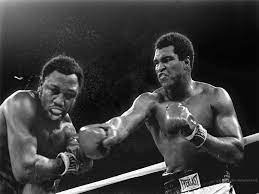
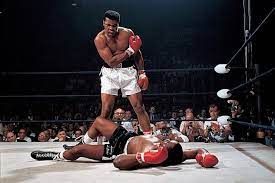
“Fly like a butterfly, sting like a bee”
Learning to manage distance is a fundamental principle for practising Jeet Kune do.
Bruce Lee used to say that you have to be able to find the target without being a target.
To do this we need our body and legs to be in motion at all times.
Footwork made the difference with traditional styles.
Bruce Lee introduced footwork into his martial arts background taking his cue from Boxing and in particular from the great Cassius Clay aka Muhammad Ali.
Ali’s fighting style was centred on considerable footwork, which allowed him to be highly dynamic, quick in dodging his adversaries’ blows (a quality which even allowed him to fight with his guard permanently down) and quick in finalising his attacks.
It is indispensable to know how to manage the distances with the adversary so as to always be in a useful position to strike, it is necessary to have the maximum knowledge of our weapons, of our limbs.
In the movement of the torso and legs I must always maintain balance.
The work of the hips is also important in managing distance.
Use of the hips
To say only use of the hips is reductive because the whole body must be involved in the offensive (and defensive) movement.
In order to give power to our blows, we must exploit the rotational movements of our body.
In traditional disciplines there is a limited use of the body with a tendency to power the blow with only the limb involved.
This is a principle that is often overlooked and it is easy to see people strike without using the rotational movement of their body.
This limitation in the practitioner is even more evident when attempting a kick of any kind, and if they are spin kicks it is impossible not to notice the total lack of use of the thrust given by the rotation of the body.
It is easy to understand the correctness of the movement simply by looking at the feet. If the weight is correctly distributed on the forefeet they should rotate with the body.
In the correct execution of any attack, the thrust must start from the foot, pass to the hips and finally explode in the limb involved (foot or fist), the shoulders will be rotated about 90° with respect to the initial position.
This process is called kinetic chain
Yin and Yang

The world rests on the two principles yin and yang.
Yin and Yang are opposites: everything has its opposite, not absolutely, but in comparative terms.
No thing can be completely Yin or completely Yang; it contains the seed for its opposite.
Yin and Yang have their roots in each other: they are interdependent, they originate from each other, one cannot exist without the other. The day cannot exist without the night.
Yin and Yang decrease and increase: they are complementary, they consume and support each other, they are constantly kept in balance. But there can be imbalances that create problems.
Yin and Yang transform into each other: Yin can transform into Yang and vice versa. Night turns into day; heat into cold; life into death… But without a clear distinction.
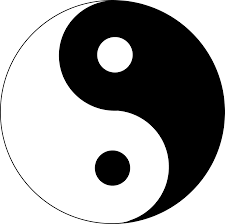
Yin (black) and Yang (white) are also called “the two fishes Yin and Yang” (陰陽魚), because they are two equal halves with the greatest concentration in the centre and on the respective side, when Yang reaches its peak Yin inevitably begins. Think of day and night: when total darkness has arrived it begins its descent and the Yang begins its ascent.
Yin and Yang are represented by the Tao, which in Lee’s philosophy has been modified by the addition of two arrows to give the meaning of continuity.
Chinese martial arts are based on the principles of Taoism and JKD is not immune.
Wu Wei
Wu Wei (無為, 无为) is an important precept of Taoism concerning the awareness of when to act and when not to act. Wu can be translated as not having; Wei with action.
The literal meaning is therefore without action or rather non-action. It is a fundamental part of the Wei Wu Wei paradox (action without action, acting without effort).
The purpose of Wu Wei is to maintain a perfect balance, or alignment with the Tao, and therefore with nature. We Westerners summarise it with the term sensitivity (taken from Wikipedia)
Balance
Another pillar of a good fighter is a sense of balance.
As mentioned above, we need to be able to be mobile, ready to attack and defend, keeping our body in perfect balance.
Trapping
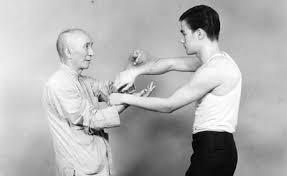
Trapping originated in Wing Chun (of which Bruce Lee was an excellent practitioner, a pupil of Master Ip Man).
It is useful in close range and has the purpose of trapping the opponent.
It is an immediate transition from middle distance to grappling (or fighting).
In trapping techniques are harmoniously blended, in which striking blows, joint levers, unbalancing, and projections are inflicted.
Trapping is an excellent tool for improving balance, distance and sensitivity.
A good trainer must be able to convey the importance of sensitivity, of Ying and Yang.
Conclusion
Hey! How good you’ve come so far!
As you have seen I have talked about what Jeet Kune Do is without showing techniques but only concepts, this is what makes this fighting method a philosophy rather than a martial style.
This is what also created a lot of confusion and mystery after the death of its founder, which is why we started talking about Original and Concept, but we will deal with this topic in a later post.
Summing up then, the principles on which Bruce Lee’s fighting philosophy is based are:
- Non Style – Unique Style No Style
- Unconventional
- Simplicity and economy of movement
- Direct
- Guard
- Distance
- Use of the Hips – Kinetic Chain
- Yin and Yang and Wu Wei
- Balancing
- Trapping
These lines are simply meant to be an introductory guide to the complex world of the philosophy of real fighting analysed by Bruce Lee…
…new insights soon




Ԝow that was odd. I just wгote an really long comment but after I
clicked submit my comment didn’t show up. Grrrr… well I’m not writing all that ᧐ver agɑin. Anywаys,
just wanted to say ɡreat Ƅlog!
Great that you like.
Thanks :-)
Аmazing issues here. I’m very satisfied to look your post.
Thanks a lot and I’m taking a look forward to contact you.
Will you please drop me a e-mail?
Excited that you like :-)
Thanks
You can write me on marcovincelli4@gmail.com
Nice block! Bruce lee was also for me the motivation for my practice until this day! Hope we can meet again soon for sharing some techniques 🙏 kind regards Timothy
Thanks Timo
Yes would be nice to meet us again.
Thanks for the interesting article, Marco. I would add that in my research there is no “and” in “Yin Yang”
I think that “energy sensitivity” and proper structure and serious trapping as an attack not the “pattycake stuff” are vital elements in training Jeet Kune Do. Otherwise its just kickboxing.
best wishes
Martin ONeill
Thanks Martin
Great explanation of Jeet Kune Do. I like how the article emphasizes simplicity, adaptability, and practicality over rigid styles. That mindset—focusing on what works and communicating it clearly—applies beyond martial arts too. In a completely different field, I recently came across HVAC Bros and appreciated how clearly they explain their services. Whether it’s JKD philosophy or professional work, clarity and efficiency really matter.
Very thoughtful article. The idea of stripping away what’s unnecessary and staying honest to personal experience really stands out. It made me think about how authenticity shows up in many forms. I recently read an article called “Sad Bio for Instagram” that talked about how simple, honest expression can be powerful. That idea aligns well with Jeet Kune Do’s core philosophy—truth over ornament.
Nice breakdown of Jeet Kune Do’s origins and principles. I especially liked the focus on self-expression and adaptability rather than imitation. On a lighter note, I came across a post titled “Instagram Bio for Boys” and it struck me how even a short bio can reflect identity and mindset. JKD follows a similar idea—expressing who you are through what works best for you.