Read or Jump On
NOTIONS OF SELF-DEFENCE
In this article, I’m going to address notions of self-defence but I will not dwell on specific topics.
I have tried to give some general guidelines in order to learn more about a subject that is in my opinion very sensitive and underestimated in the various courses
Aggression is considered an instinctual impulse (at the hypothalamic level); In animals it is related to survival, whereas in humans it is more a behaviour aimed at hurting, both physically and psychologically.
The dictionary, under the entry aggredire, states: ‘to hurl oneself at someone with violence’; ‘to assault’; ‘to address with offensive words’.
Obviously, for there to be aggression, we must consider the presence of at least two characters:
AN AGGRESSOR: the individual who knowingly engages in aggressive behaviour aimed at harming the other person;
A VICTIM: the individual who suffers the aggressive act.

Main categories of violent behaviour
Violent behaviour that can lead to a physical confrontation can be divided into 4 main categories:
- FEAR: is that form of violence triggered by a person feeling threatened by a situation, an individual or a group of individuals.
It is usually a reaction to stimuli that send the person into a state of panic and poor mental clarity.
- DELIRIO: the violence of those who perceive no limits of any kind (physical, moral, social…).
This category includes those who are under the influence of drugs and/or alcohol.
- IRRAGIONAL RAPE: violence provoked in an ‘intentional’ manner, based on unreasonable self-feeding behaviour (possible psychotic syndrome).
It is one of the most difficult situations to be in. In this case it is advisable
- try to remove the ’emotional trigger’ from the aggressor;
- try to make the opponent understand that his behaviour and demands will not be met and tolerated any further.
- CRIMINAL: violence used coercively to obtain something from someone.

Different types of aggression
The different types of aggression can be divided into six broad categories:
- Verbal aggression;
- Assault by drunks or drug addicts;
- Assault for the purpose of robbery;
- Assault for sexual purposes;
- Assault with the purpose of causing bodily harm to a person;
- Assault by a pack.
A good training should make it possible to recognise, with a
good approximation, the intentions of a potential aggressor and thus be able to
organise a form of defence appropriate to the situation. This will minimise
damage and danger to oneself and others.
Mental alertness
Another very important issue in the area of aggression is undoubtedly mental alertness.
Paying attention to what is going on around us by making it a real mindset is very important when it comes to safety, whether on the road or at home.
Not paying attention to what is happening around us makes us passive in the face of the possibility of perceiving in time those signals and behavioural details that could be premonitory of risky situations, of sudden and violent events.
Levels of attention
Four levels of attention are known
WHITE LEVEL: is the state of natural relaxation.
YELLOW LEVEL: the general state of the person is relaxed, but you are aware of where you are and what you are doing, ready for whatever might happen. This is the state of mind we should always be in.
ORANGE LEVEL: This is a specific alert condition. In these circumstances, one prepares oneself for real dangerous situations and tries to carefully assess possible escape routes.
RED LEVEL: There is an attack in progress. At this stage, there is nothing one can do to save oneself but fight or flee.
Prevention
The best form of self-defence is, without any doubt, to avoid finding oneself in the situation of having to defend oneself.
Any confrontation, intended or unintended, always leads to physical, legal, psychological, ethical consequences.
This is why it is essential to remember that prevention is the first form of self-defence to be put in place and for this reason it must become a true ‘mental status’.
Sometimes little is needed to prevent possible unpleasantness:
- avoid bad places, secluded places, gardens or poorly lit areas;
- close car doors when stopped at traffic lights or in a poorly lit car park; do not keep valuables on the dashboard and seats;
- at home, in addition to locking the door, be careful when returning home in the evening, and so on.
All too often, there are omissions in ‘reading’ the situation, the context, the relationship, which can easily lead the individual to find himself in unpleasant contexts that, can degenerate abruptly.
Once caught off guard, it is easy to become overwhelmed by the fear and tension of the moment, thus losing the possibility of defusing an ‘escalation’ or a mechanism of ‘favourable opportunities’ for the aggressor himself.
The reality is that sometimes we are attacked precisely because of superficiality, distraction, underestimation of the place and the person in front of us, and first and foremost because from a behavioural, psychological and emotional point of view, we were unable to handle the situation.
Safety Distance
Phases of aggression
As a rule, in human behaviour there are ritual aspects that accompany or precede an act of violence, actual phases that lead to the aggressive phenomenon:
- Visual phase;
- Verbal phase;
- Making contact;
- Actual combat.

SAFETY DISTANCE
As mentioned above, the first thing to do is to assess the situation; there are aggressions and aggressions, just as there are aggressors and aggressors. A driver irritated by a long day’s work cannot be considered on the same level as a robber looking for a victim.
The SAFETY DISTANCE is a fundamental element.
In the normal dynamics of aggression, it is surprising how easily the attacker can approach the victim without the latter doing anything to prevent it.
Just as, in combat sports, distance is a ‘carrier element’ for determining the appropriate offensive action, so, in self-defence, it serves to manage the situation and organise an appropriate defence.
The reason why many people are easily overwhelmed during an attack is not only due to inadequate physical and psychological preparation, but is also due to a lack of familiarity with the appropriate ‘tactical assessments’ to be made in certain circumstances.
When we talk about safety distance, we must imagine that we are erecting an ‘imaginary wall’ around us that no one must cross without our consent.
Beyond our fence, a stranger can potentially become very dangerous.
For it to be defined as ‘safe’ the distance to my opponent must be about 150 cm; in borderline cases, it may be equal to the length of our leg stretched forward.
Below 50 cm (‘interpersonal area’) the human body has the defect of slow reactions, so that from this distance, whoever takes the initiative to strike has a great chance of succeeding without being able to be stopped in time.
Types of aggressive actions
Aggressive action can occur:
FOR HONOR (HOT AGGRESSOR): a bully, a husband betrayed by his wife, a bully. He usually attacks in a showy manner, insulting, using a high tone of voice.
FOR INTEREST (COLD AGGRESSOR): a mugger, a criminal, a robber. He assaults for money, cars, jewellery, valuables.
Of the two types of aggressor, the most dangerous is the one who attacks out of interest because he does not attract attention, is devious, tries to go unnoticed, shows no outward signs or particular emotions. He usually tries to approach the victim using attitudes designed to divert his intentions, e.g. by asking for the time, a street, some change, etc.
If a suspicious person approaches using dialogue or distraction (e.g. by insistently asking for a cigarette), the most appropriate move is to keep a safe distance with an ASSERTIVE ATTITUDE.
Backing away in a dishevelled manner is a symptom of fear and this may fuel the attacker’s intent to attack, but, as mentioned, one cannot allow the attacker to enter our safe area either. We must protect the distance by moving back two or three times (maintaining a suitable postural technique) but no more, so as to send, first of all, the message that we do not want trouble by immediately attempting a de-escalation, but making it clear that we are ready for a confrontation.
If faced with danger, the first thing to do is to move away; if one cannot escape, it is advisable to try to resolve the threat ‘nicely’; if this option also proves unsuccessful, the only thing to do is to confront the aggressor.

Assertive Behaviour
Faced with an impending verbal or physical conflict, accepting a complementary role (‘I don’t want to fight’) is often not enough to avoid the worst.
One thing is certain, however, establishing a symmetrical relationship (‘I am the stronger one’, ‘No, it’s me’) will provoke an escalation that will lead the two contenders to a certain confrontation.
Each of us possesses a specific character that sets us apart.
Behavioural categories
To simplify matters, we categorise individuals into three broad behavioural and communication categories:
PASSIVE TYPE: people who are inclined to ‘suffer’ others, not used to reacting, to asserting their own convictions. They usually show submissiveness, condescension, are not proactive. In unpleasant situations, they will manifest ‘passive resistance’, a behaviour that will encourage the aggressor to pursue his intent (a woman who, terrified, shows condescension in front of her rapist may have her life saved, but will certainly not avoid violence).
AGGRESSIVE TYPE: a person not particularly inclined to compromise, who tends to prevail, to dominate and command over others, animated by the desire to assert his own point of view without evaluating that of others. Those accustomed to such behaviour are particularly exposed to finding themselves in unpleasant situations, especially when confronted by someone more aggressive. Under these circumstances escalation is assured, unless one of the two contenders withdraws first, and will certainly lead to a confrontation.
ASSERTIVE TYPE: A reasonable person, able to respect others while asserting his or her own convictions. These individuals know how to assert themselves without subjugating others; they do not attack, do not humiliate and try to deal constructively with differences. When faced with emergency situations, they try to quell the escalation while still maintaining a firm and decisive attitude.
In a situation of physical risk, adopting assertive behaviour will certainly give us a better chance of avoiding confrontation and bringing home the skin.
In setting up a proper defence, both words and body signals must be evaluated.
In fact, certain communicative behaviours are to be avoided at all costs.
It is important to always remember that although one should not show physical and communicative passivity, any reaction must be intelligent and genuinely useful.
Enticing my opponent makes no sense.
Behaviours for dealing with aggression
It is useful and important to try to:
KEEP A SAFE DISTANCE (as far as possible).
MAINTAIN A CORRECT POSTURE: stand upright but not leaning forward, keep your shoulders broad, be relaxed but ready to move.
USE A CAPACIZED AND UNIFORM VOICE TONE: raising the vocal timbre will stimulate an adrenalin rush in my attacker and increase his arousal. Also avoid slowing down the cadence of words; this is often interpreted as the start of a physical attack.
USE AN EXPRESSION OF THE FACE THAT IS ATTENTIONATE BUT NOT ATTACKED, NOT MINACIOUS: if possible, show a serene, open gaze towards the opponent (try to manage tension as much as possible).
USE A DIRECT CONTACT WITH THE OPPONENT: those who are afraid tend to lower their gaze. Remember, however, not to use an inquisitorial gaze.
GESTURE BUT NOT EXCESSIVELY: a cleverly used gesture serves to distract the intruder and give us an image of tranquillity.
EXPLOIT THE SITUATION TO OUR ADVANTAGE BY SEARCHING FOR A WAY OUT: communicate with the opponent without letting yourself be carried away by your own EGO. Knowing how to put pride aside in order to defend oneself or someone in our company. E.g., ‘you were looking at my woman’ ‘yes, you are right, sorry. I mistook her for my cousin”…
Behaviours to avoid
Likewise, I should avoid
- offend
- insult and demean
- raise my voice
- be submissive
- show fear, discouragement
- do harm without completing the action
With these and other behaviours I would only end up worsening my condition by increasing the aggressiveness of my opponent.
Obviously, being calm and lucid in front of an aggressor who threatens us, in front of a rapist or even in front of an armed person is not easy or instinctive. It takes proper, long and arduous training.
Good training can indeed make us store up assertive behaviour to be used in a variety of situations: from work to a dangerous context.
However, an aggression is not only a violent event but is often also very rapid in its evolution. Sometimes one does not have time to speak but only to act. It is therefore clear that it is not always possible to protect oneself by trying to dissuade and calm the adversary. In some cases, it will be necessary to react immediately while maintaining good emotional control.
The ability to improvise is a fundamental resource for getting out of difficult situations.
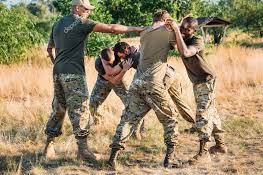

Fear, knowing how to manage
A subject under conditions of particular stress or emotional tension, faced with a sudden, strong fear, activates what is called ’emotional thinking’. In this phase, the brain areas of the limbic system and the amygdala are affected. (see here to know more)
Which give immediate and semi-conscious behavioural responses (bypassing the neocortex) and offer a condition of hypervigilance.
This is an instinctive condition, oriented towards immediate action, which sees the individual ‘controlled by emotions’.
Fear is a natural condition, which is why it is important to accept it and learn how to manage it.
Knowing how to control one’s fear is more important than having an extensive technical background in martial arts and combat disciplines.
It is reported that many strong athletes in the ring have then failed to defend themselves in the street, despite facing opponents with no martial arts experience.
This is because their lack of preparation in street defence and the adrenalin they developed at the time greatly disadvantaged them, making them unable to cope with the situation.
Usually our brain, in an unaccustomed condition such as a sudden danger or an unaccustomed sudden situation, is as if paralysed, if it goes haywire.
Importance of training
This is why it is important to train constantly by developing what is called ‘muscle memory’ (stimulus-response reinforcement).
This is because my brain and muscles have recorded and memorised these movements and are ready to pick up all the forgotten information and connections once the same external conditions re-establish themselves.
Getting overwhelmed by fear on the street can mean losing before you even start.
A good martial arts course prepares students by simulating dangerous situations and subjecting them to stressful conditions; of course, physical preparation and a broad technical background should not be neglected.
Knowing how to use one’s body under extreme stress conditions is fundamental to good self-defence.
Conclusions
I know it was a long topic and again without talking about technique.
As you see there are several thing to take in account when we are talking about real fight for defence.
As I wrote we can be expert fighter inside a Gym or a Martial Art Champ but face an assault is a different things.
It’s not a case that special forces are trained in specific stress conditions.
Who train a military does not have years of training available and he must forge a warriors in a few months/weeks to make the difference between life and death.
Yes may be a military it may seem an extreme example but unfortunately handle an aggression is not a joke and that way I like distinguish between Self-defence class and Realfight class.
In this article we have seen an overview of most of the element to be considered, I will create more specific article over time but I think it is important to immediately give an imprint to the blog which, as written here, was created to deal with the hidden part of self-defense. To highlight those topics that are often overlooked in a standard course or in the various videos available on the net.
I hope you enjoyed the article, please let me know your opinion about it