Read or Jump On
stress and performance in combat
In the previous article on self-defense concepts, I did not dwell on specific issues but simply tried to report general guidelines.
I now want to focus on a fundamental aspect related to dealing with street aggression/fighting: stress management
As I have repeatedly pointed out knowing combat techniques can be useful in the case of aggression but (as also seen here) in reality the situation is quite different from what is experienced in the gym, on the street where so many of the nice little things we have learned become difficult to put into practice because our body loses “lucidity”
One thing I learned the hard way.
As a security officer I once had to handle a fight with colleagues and in defending myself from an attack I found myself on the ground. This fact made me think a lot.
What had happened! In the gym I have always had very good balance and my body is always stable in protecting myself and hitting, and yet that time despite my preparation, without even being hit, something in my balance failed and I fell “alone!” Fortunately on that occasion a nearby colleague protected me and helped me up.
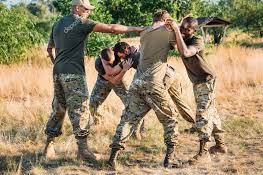
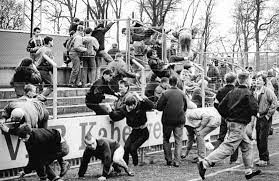
Stress creates different states of mind, and readiness to act during different levels of situational awareness also varies. These different Levels of Attention were color-coded by Colonel Jeff Cooper
According to Cooper, the most important means of surviving a deadly confrontation is neither weapon nor martial skills. The main tool is the “combat mindset.”
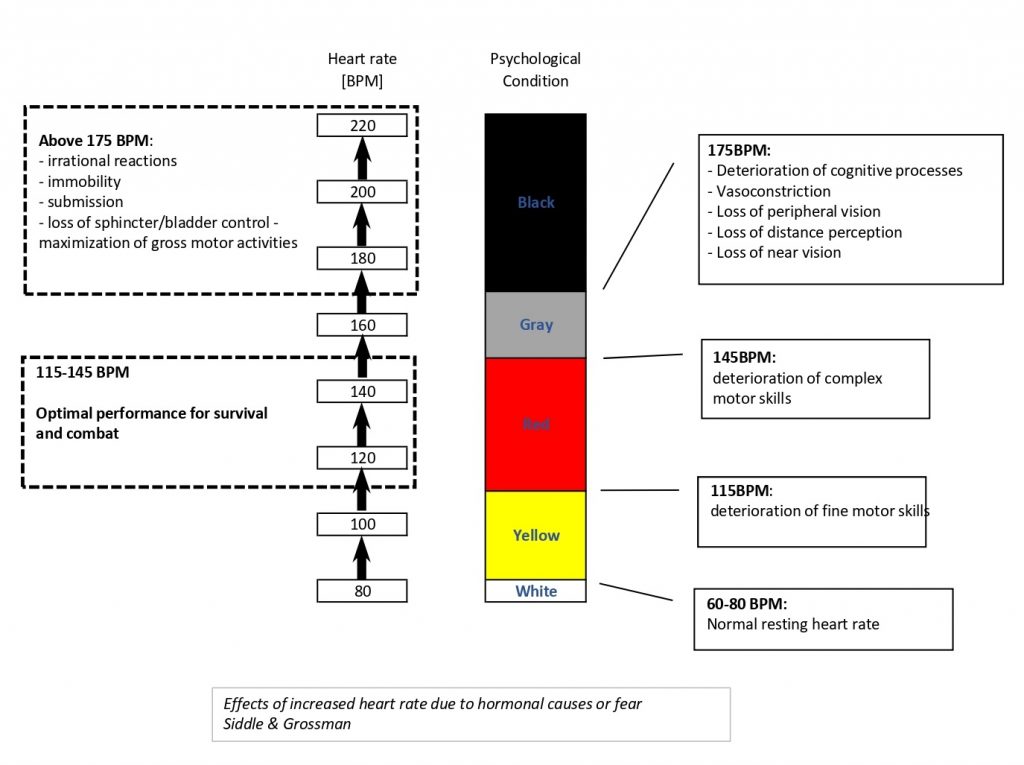
More recently, Colonel Dave Grossman has analyzed the increases in heart rate with which different Levels of Attention are associated, creating a very interesting explanation of what happens when we are under stress from survival and fear
To fully understand the intensity of mental stress resulting from combat, we need to consider other environmental stressors, and at the same time study the physiological responses of the body related to the sympathetic nervous system. In addition, it would be appropriate to analyze the fallout caused by the sympathetic nervous system when it is overloaded
In this article, we will examine the effects of increased heart rate due to hormonal causes or fear through activation of the sympathetic nervous system.
Similar increases in heart rate due to exercise do not have the same effects.
Sympathetic nervous system (SNS) and parasympathetic nervous system (SNP) – SNA
A quick introduction to the autonomic nervous system (ANS) is helpful in understanding the concepts that follow.
The SNA operates without conscious, voluntary control. Blood pressure regulation, gastrointestinal responses to food, urinary bladder contraction, ocular focus, and thermoregulation are just a few of the many homeostatic functions regulated by this system (McCorry, 2007).
The sympathetic nervous system (SNS) is a part of the autonomic nervous system that prepares the body for action in times of stress; it enables this by increasing the metabolic rate and engaging much of the body’s resources to cope with the situation (Feldman, 2014).
The parasympathetic nervous system (SNP) is opposite to the SNS. Both are independent but promote balance in the body. The SNP is that part of the autonomic nervous system that calms the body after a stressful situation in which the sympathetic nervous system has participated.
It is the means of conserving energy resources (Feldman, 2014)
Some main differences:
The parasympathetic system stimulates activities that occur under normal conditions to ensure long-term well-being (e.g., digestion), while activation of the sympathetic system is used to deal with short-term emergencies (Redolar et al., 2010).
Sympathetic nerves stimulate, organize and mobilize energy resources in emergency situations; while parasympathetic nerves act by conserving energy (Pinel, 2007).
Sympathetic changes indicate psychological activation, while parasympathetic changes indicate psychological rest (Pinel, 2007).
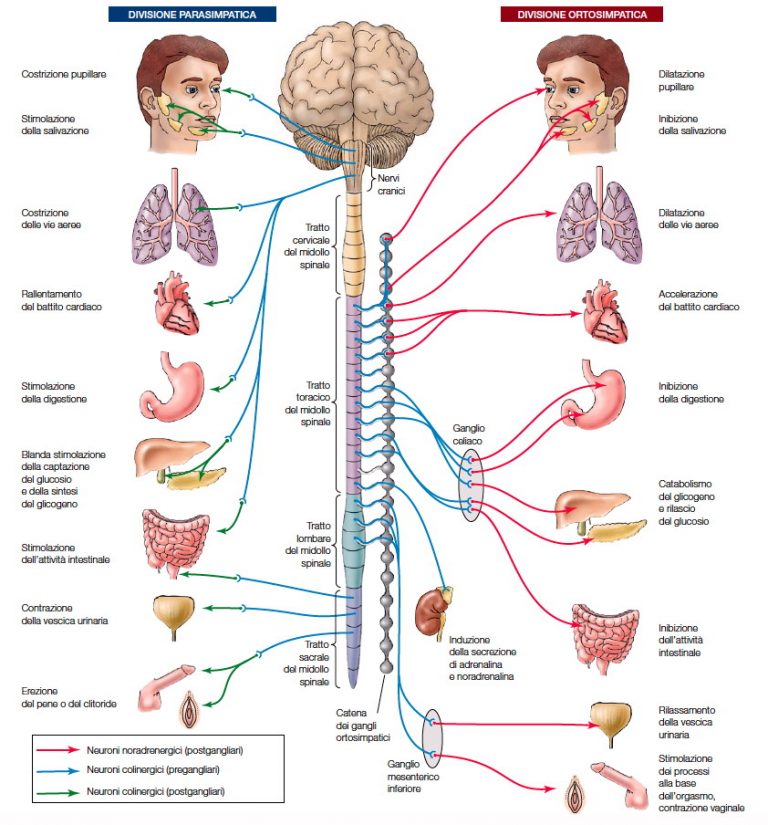
The sympathetic and parasympathetic nervous systems are antagonistic. Due to their synergy, the organism keeps itself balanced and is able to adapt to very different circumstances.
In terms of combat we can compare SNS to soldiers directly involved in combat and SNP to support and maintenance personnel. In a relaxed and routine condition the two systems are in a balanced condition (homeostasis) but at the time of an attack we have a total activation of the SNS and SNP processes are blocked. Our body selects what is necessary for us and considers that activities such as digestion, salivation, etc., are not necessary.
With the danger gone the opposite thing happens with a true parasympathetic collapse. (blackout)
Napoleon said: The moment of greatest vulnerability is the instant immediately after victory.
The moment of greatest vulnerability is consequently the moment following the scuffle and victory.
To avoid becoming vulnerable after an objective has been achieved, it is important to train oneself to automatically undertake tasks to keep oneself engaged and maintain a state of alertness until a completely safe situation is reached. In the military environment, the acronym L.A.C.E. (Liquids, Ammunitions, Casualities, Equipment) is used
Activation levels
The color code
Col. Cooper Lieutenant Colonel in the Marine Corps, fought in World War II and the Korean War. He is considered among the most distinguished and early pioneers of Warrior Science.
An important concept introduced by Col. Cooper is the color code; this code schematizes the mental states and attitudes that lead an individual to face a potential danger, from which he or she might necessarily defend himself or herself through the use of a weapon.
According to Cooper, the code refers to the actions the individual will need to take to resolve a potentially dangerous situation by moving from one level of the color scale to another.
The Cooper color code system is about a state of mind, not a physiological one.

Effects of increased heart rate
Col. Grossman, in collaboration with Bruce Siddle, later wrote an article on the “Psychological Effects of Combat” starting with the topic of heart rate related to performance levels and creating a combined model of stress and performance.
Colonel Dave Grossman is among the leading experts in the field of human aggression and combat psychology.
It is important to point out that setting precise boundaries to heart rate values for various color conditions is not entirely correct as these can be subjective depending on factors such as fitness or other factors.
As mentioned at the outset, the heart rate increases I will discuss below are related to survival stress situations. Similar frequency increases due to physical exertion do not lead to the same psychophysical effects. The two causes can add up, however.
Therefore, it is necessary to keep in mind that each of us has his or her own color condition, and the following should not be applied literally to each of us.

White Condition
When you sleep or are in complete relaxation you are in the lowest situation of readiness called the White zone.
And the prey level.
It’s like an apathetic psychological state in which unfortunately many people live
Yellow Condition
When you are in a state of awareness of what is happening around you but do not feel threatened you are in the yellow condition.
You are in a state of alertness and readiness and prepared for possible combat.
Between White and Yellow condition the difference is mainly psychological and not physiological. There is no specific heart rate associated with it, and still we can say we are below 115 heartbeats (bpm).
The Yellow condition is where we are, for example, when we are driving. We are relaxed but in a state of alertness that we need to keep an eye on the road and other cars so we can avoid accidents.
Red Condition
In this condition we are in the ideal state of performance to face a fight and to survive.
The bpm are in a zone between 115 and 145.
In this condition complex motor skills and reaction times are at their highest levels.
It should be kept in mind, however, that starting at 115bpm you have the first symptoms of vasoconstriction resulting in reduced blood flow to the extremities. The most classic example you have following a trivial tamponade.
The resulting stress reaction leads to difficulty writing because of hand tremor or difficulty speaking and expressing oneself quietly.
Fine motor skills begin to deteriorate.
Grey and Black Conditions
Above 145bpm one enters a psychological condition of high stress in which the first symptom is deterioration of complex motor skills.
Here other interesting factors often unknown or hidden take over for which I think it is interesting to devote a subsequent article.
Conclusion
Situational awareness is the conscious decision to be aware of our surroundings and the activities taking place there.
In order not to be completely unprepared for unusual behavior and potential threats, it is helpful to be relaxed but at the same time be aware of the people and sounds around us.
It is a state of mind we get used to, which does not mean being a paranoid but analyzing situations to be ready to protect ourselves and the people around us.
Very often an attack is not aimed directly at you but you may find yourself involuntarily involved. The right state of mental alertness helps keep you from finding yourself in situations that tend to be dangerous.
This is The Law of Self-Defense.
Summarizing
To conclude we see a further simplification of the color code seen in this article
White – BAD AND IMPREPARED – Unprepared and not ready to take lethal action. If you are attacked blankly, you will probably die unless your opponent is totally incompetent.
Yellow – RELAXED NOTICE – I may have to defend myself at some point today.
In the yellow state, you are in a relaxed state of vigilance.
Orange – SPECIFIC WARNING – something wrong has caught your attention and you are focusing mainly on it, you are ready to take action, but you are not in a lethal mode.
Red – COMBAT – You are in lethal mode and will act immediately with deliberate aggression if the circumstances warrant it.
Bibliographic sources.
Dave Grossman, “On Combat”