Read or Jump On
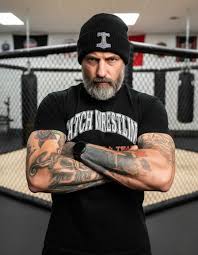
Interview with Mauro Sacchetto – JKD/Kali instructor and trainer for law enforcement
There is a lot of confusion in the world of self-defense. Spectacular techniques, unrealistic promises, and “definitive” systems that only work in theory.
But what really works when the situation becomes real?
I asked for the perspective of someone who has been working in the field for over 30 years.
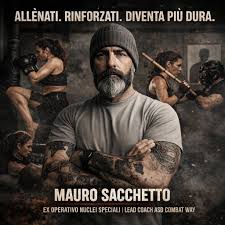
Mauro SACCHETTO is a first-generation JKD/Kali instructor in Italy. He has been teaching these methods since 1992.
He is an instructor of close-quarters combat tactics for the police and a police self-defense instructor.
Let’s find out what really works in real-life self-defense: techniques, training, and practical advice.
What really makes a self-defense course effective?

The answer is simple, but uncomfortable: pressure.
If you train without stress, without real resistance, without an opponent who reacts, you aren’t learning to defend yourself. You’re just going through the motions.
An effective course must include:
realistic scenarios
space management
uncooperative opponents
physical and mental stress
And today more than ever, it must adapt to current social realities.
Furthermore, it is also useful to consider prevention and the use of legal self-defense tools (such as pepper spray or noise devices).
Defense doesn’t begin during the confrontation, but before it.
Is there a more suitable style?
There is no such thing as the perfect style; there is only the well-rounded athlete.
Styles alone aren’t enough. What matters is developing a comprehensive system.
Choosing disciplines such as:
MMA
Grappling
BJJ (Brazilian Jiu-Jitsu)
offers a major advantage: they get you used to real-world contact.
If you don’t know what it means to get hit or end up on the ground, your body and mind will panic at the first impact.
Which techniques are really necessary?
Not many. But they must be automatic.
In a real-life situation:
- adrenaline reduces coordination and precision
- complex movements fail
It’s better to focus on:
- simple, effective strikes (palm strikes, low kicks)
- distance control (clinch)
- takedown defense (sprawl)
- quick escapes from common holds
The principle is clear: simple beats complex.
Physical fitness: How important is it?
That’s what matters most.
If you’re out of breath after 30 seconds, you have no time to react.
The fundamental qualities are:
endurance
explosive strength
the ability to recover under stress
Physical conditioning is what makes the techniques effective.
If you can’t run, you’re fair game.
Explosive strength and lactate tolerance are your life insurance.
Mental Preparation: Training the Mind Under Stress

This is where the real difference lies.
You need to train with conditioned sparring
- think when you’re tired
- make decisions under pressure
- manage panic
This is developed through:
- conditioned sparring
- high-intensity drills
- realistic simulations
That’s where the truth emerges: not who you are “at rest,” but who you are under pressure.
Read here about stress in combat
Is ground fighting really necessary?
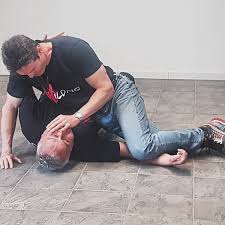
Yes. Even though many people underestimate it.
Anyone who says there’s no point in fighting on the ground has never been in a real fight.
On the street, you don’t get to choose whether to end up on the ground:
- you might slip,
- get shoved,
- or face someone heavier than you.
Without basic grappling skills:
- you won’t know how to get back up,
- you won’t know how to defend yourself,
- and you’ll lose control of the situation.
It’s not the ideal situation, but it’s a real possibility. And ignoring it is a mistake.
Knife Defense: The Unvarnished Truth

How to Defend Yourself
Total honesty is required here. I believe it only makes sense to talk about this if you understand that it’s about damage control, not “defense.”
If someone has a knife and knows how to use it, the risk of being injured is extremely high.
There are no clean solutions.
If you can, run away. If you can’t, the priorities are:
- avoid
- escape
- create distance using objects
Focus on the armed arm?
Yes and no. You have to control the limb, but if you only look at the blade, you don’t see the rest.
In Kali, I teach that you must control your opponent’s “motor center” while trying to neutralize the immediate threat.
How do attacks happen?
Not like in the movies. They’re rapid, piston-like, close-range, and often you don’t even see the blade until you feel the heat of the blood.
Disarming: when is it possible?
“Disarming” is an extreme and highly risky solution.
I would never bet my life on a disarm.
How should you train?
Training realistically (with markers or simulators) serves precisely to understand one thing: there is no such thing as the perfect technique; there is only damage control.
Jeet Kune Do, Evolution, and Modern Systems
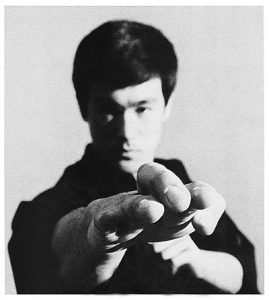
Original JKD vs. Concept?
Original JKD preserves Bruce Lee’s original technical framework, which is a good starting point; the Concept (the one we follow with Bob Breen and Erik Paulson) uses Lee’s principles to incorporate all the new and effective techniques that have emerged in recent decades (such as modern wrestling or dirty boxing). I’m all for evolution.
Today, all effective systems have one thing in common: they are hybrids.
The concept introduced by Bruce Lee is now the standard:
absorb what works, eliminate what doesn’t.
Comparison with Krav Maga?
Krav Maga has excellent marketing and valid concepts of aggression; I am not an expert on the method, so I won’t delve into its validity—I speak only from what I know.
Whether we’re talking about JKD, MMA, or other modern systems, the direction is clear:
adaptation and pragmatism.
Rigid styles belong to the past.
Lee’s idea of breaking down the barriers between styles has become the global standard.
Conclusion
Self-defense isn’t a choreographed routine. It’s about managing reality.
You don’t need to know a hundred techniques. You need to know how to use just a few—under stress—when it really counts.
True self-defense begins with awareness, physical conditioning, daily choices, and the ability to read a situation before it escalates.
For this reason, choosing the right path is fundamental, and there are no shortcuts.
Technique, conditioning, stress management, and personal discipline all work together. Neglecting one means leaving the entire system vulnerable.
Training isn’t just about learning to react; it’s about improving mental posture, confidence, resilience, and decision-making skills even outside the context of conflict.
Being “safe and fit” means exactly this: not choosing between safety or physical fitness, but building both.
But above all, defending yourself does not mean winning a fight.
It means getting home.
And this requires clarity, awareness, and constant training.
Train to feel better.
Prepare to be ready.
Invest in yourself, because you are your first line of defense.